Do the World's Best Players Play the Openings That Suit Them?
What 200 classical games reveal about Carlsen, Caruana and two very different ways to build opening competence.
Summary. Carlsen and Caruana build their opening repertoires differently. Carlsen spreads his choices across a broader range of systems and reaches substantially cleared central pawn structures more often. Caruana returns more frequently to concentrated theoretical territory. Yet across 200 classical games, neither architecture produced a measurable advantage in opening evaluation, expected score, player-caused error, or volatility. Opening fit may therefore be less about finding the repertoire that scores highest according to an engine, and more about building one whose theoretical, structural and decision-making demands match how the player develops and applies competence.
About the author
Stefan Rebner is the founder of RBOTChess, a chess-development project for players who want to turn chess information into usable competence. After a career working with development strategy, business cases and implementation, he now applies the same process-driven approach to chess training—particularly for players rated 1200–2000. The guiding principle is simple: Know what to do next.
The RBOTChess Opening Fit Project
This is the first article in the RBOTChess Opening Fit Project — a series that applies the same question to different pairs of elite players: not which repertoire is objectively best, but what a repertoire's structure reveals about how its owner builds and uses chess competence. Carlsen and Caruana, with their well-documented and strikingly different approaches to opening preparation, were the natural starting point. The next article in the series will turn to the reigning World Champion, Gukesh, and his 2026 challenger, Javokhir Sindarov, ahead of their World Championship match.
Twelve draws and a mystery
In November 2018, Carlsen and Caruana played twelve classical games for the World Championship. All twelve were drawn. Some were tense, a few were sharp, but none produced a decisive result — an outcome so complete that it briefly became a talking point of its own: had the two best players in the world simply neutralized each other?
Then came the tiebreak. Four rapid games, faster time control, same players, same board. Carlsen won the first three outright and the match was over before the fourth was needed: 3–0.
It's tempting to read a narrative into that swing — that Carlsen's chess is somehow more "flexible" or Caruana's more "fragile" under time pressure, and that this must trace back to how each man prepares his openings. We are not going to make that claim. A three-game rapid sample is far too small to diagnose anything about opening repertoires, and the classical match itself is the strongest evidence available that, over the long format both players know best, their chess was essentially inseparable. What the 2018 match does give us is a good question, cleanly stated: two players who are reported to prepare very differently can play twelve classical games at the highest level and remain dead level. Is that because their opening repertoires are, in fact, objectively similar in quality — or because two different approaches can each be made to work equally well, provided the player behind them applies it consistently?
We can't answer that from one match. But we can measure it across many.
Two repertoires, built differently
Set the 2018 match aside and look at what each player actually plays, across each player's 100 most recent eligible classical games. Because fewer eligible Carlsen games were available during the more recent period, his 100-game sample reaches further back — from January 2023 — while Caruana's begins in October 2024. The samples end in May and June 2026 respectively. We kept these different time windows visible throughout the study rather than pretending they were identical, and retested the principal findings within a shared period using equal-sized comparisons.
The first thing that shows up is breadth. We grouped the openings into families and measured how heavily each player concentrated on a small number of them. Carlsen's choices were spread across a significantly broader range. Caruana returned more often to a smaller, more recognisable set of systems. The difference remained when we compared equal-sized samples from the same time period: in that shared-period test, Carlsen's repertoire was broader than virtually every comparable Caruana sample.
The second thing that shows up is what kind of position each repertoire tends to produce. Looking at the position on the board after move 20 — well past the opening proper, at the point where a repertoire's practical consequences are visible — we measured how often each player reaches a position with few central pawns left on the board. On the broader measure — at most two central pawns remaining, for either side — Carlsen reached substantially cleared centres in 64.3% of his positions, compared with 48.5% for Caruana. Under a much stricter definition — no remaining d- or e-pawns for either side — the figures were 8.2% and 3.1%. Both measures point the same way, and both survive the same conservative equal-size comparison used above.
A cleared central pawn structure is not the same thing as a simple, quiet, or purely technical position — a cleared centre can just as easily open lines for a sharp attack as it can lead to a technical endgame. All the measure tells us is how often central pawns have left the board by move 20, not what kind of position results from that. With that caveat in place: Carlsen ranges more widely across opening systems and reaches a cleared central pawn structure more often. Caruana works a narrower set of systems and more often keeps a fuller central pawn structure on the board. These are not subtle statistical artifacts — they are close to the strongest, most consistent signals in the entire dataset.
Two routes to move 20
The two findings above are easiest to see side by side. Both boards below are real positions from the study's sample, at the same checkpoint — move 20 — chosen because they cleanly illustrate the group-level pattern, not because either is claimed to be either player's "typical" game.
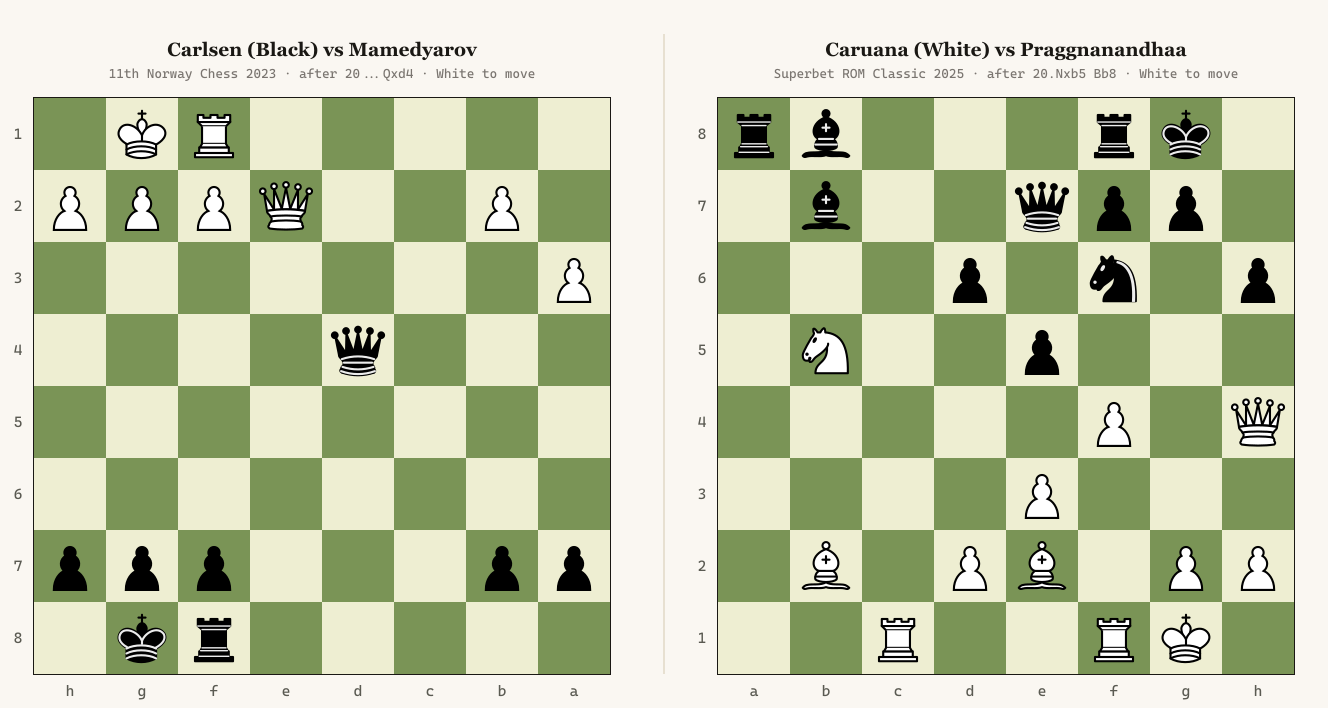
Right — Caruana (White) vs Praggnanandhaa, Superbet ROM Classic 2025. Four central pawns remain, with the f4/e5 pair still in active tension. This is representative of the fuller, more contested centres Caruana's repertoire reaches more often than Carlsen's — one illustration among many, not a claim about his "typical" game.
What doesn't differ
Here is where it gets interesting. None of that translates into a measurable difference in how well either player's opening play scores.
We ran a Stockfish 18 evaluation on every sample position at moves 10, 15, 20 and 25, from the perspective of the player whose repertoire was being tested, and checked six primary outcomes: the engine's evaluation at move 20, the position's expected match score (win/draw/loss odds converted to a single number), how much of the evaluation swing through move 20 was the player's own doing rather than the opponent's, how volatile the evaluation was through the middle of the opening, and the same two central-control checks using a separate structural measure (Central Control Score, described below). Every one of the six was tested not just on the raw sample, but split by colour, by opponent strength, and — for the two most sensitive of them — checked against every possible single-tournament removal, to make sure no one event was quietly driving the result.
None of the six measures showed a reliable difference between the players. The small numerical gaps were inconsistent across colours, opponent strength and time periods, and were too small to support a meaningful distinction. Carlsen's breadth does not correspond to worse evaluations, more self-inflicted error, or more volatility than Caruana's narrower repertoire — and Caruana's concentration does not correspond to measurably cleaner or lower-loss play than Carlsen's breadth. Whatever advantage either approach confers, it is not visible in the objective quality of the resulting positions, at least not in the opening-phase measures we followed through move 25.
This matters because it rules out the easiest, laziest version of the story. It would be a tidy narrative if the data showed "Carlsen's breadth costs him a little precision, but he makes it up elsewhere" or "Caruana's depth buys him measurably safer positions." Neither is true. Two structurally different ways of building an opening repertoire, played by two of the best players alive, produce statistically indistinguishable objective results.
How would they answer the RBOTChess questionnaire?
Neither Carlsen nor Caruana has completed the RBOTChess training-plan questionnaire — the short set of questions the site actually asks a member before building a personalised study plan, covering things like preferred learning mode, planning style, and what a player does immediately after a game. What follows is not a personality test result and not a psychological diagnosis. It is an informed guess, and the table below keeps the three things a reader needs to be able to tell apart — what the games show, what each player has said publicly, and what RBOTChess infers from combining the two — visibly separate. Treat it as illustration, not verdict. Both men are, without qualification, elite at preparation, calculation, intuition and positional judgment; the differences below are about emphasis, not chess ability.
| Questionnaire dimension | Carlsen — inferred emphasis | Caruana — inferred emphasis | Evidence |
|---|---|---|---|
| Planning preference | Reaches a playable position and decides the rest at the board | Prefers knowing the terrain in detail before arriving at it | Public preparation accounts1 2 (medium confidence) |
| Repertoire architecture | Breadth: choices spread across many opening families | Concentration: recurring, narrower set of systems | 100-game study (high confidence) |
| Training style | Comfortable adapting once prepared lines run out | Comfortable returning to a well-mapped, rehearsed structure | Repertoire pattern + public accounts1 2 (medium confidence) |
| Learning application | Applying general understanding across varied central structures | Deepening knowledge inside a smaller set of well-verified positions | Inference from repertoire pattern only (lower confidence) |
Caruana's preparation was visible in game 2 of the 2018 World Championship, where a deeply prepared Queen's Gambit line surprised Carlsen and forced him to spend considerable time deciding whether to enter Caruana's analysis.1 Carlsen has said that he enjoys the middlegame and endgame more than opening study, that he often learns simply by looking through recent games, and that computers played little role in his early chess development.2 Both accounts are consistent with — not proof of — the repertoire pattern measured above; we are not treating either player's public remarks as a direct report of a private questionnaire answer.
The honest version of the claim is narrow: the way each player has chosen to build opening competence — what a repertoire this broad or this concentrated repeatedly asks of its owner — differs in a way that is visible in the data and consistent with what each has said about how he works. It is not a claim that one process is superior, or that either player's calculation, intuition or preparation is anything less than exceptional.
Central Control Score: a second lens, not a verdict
The engine evaluation above measures one thing: who stands objectively better, by Stockfish's calculation. We also computed a separate, purely structural measure — Central Control Score (CCS) — which looks only at central pawn occupation and piece control of central squares, with no search or tactical calculation involved.
CCS does not distinguish Carlsen from Caruana on average or in volatility, any more than the engine evaluation does — another null result. More interesting: CCS is close to statistically independent of the Stockfish evaluation across the whole sample. In roughly one position in nine, the two measures point in outright opposite directions. That divergence isn't a flaw in either measure — it's the useful part. In one Caruana–Gukesh position, for example, Black's pieces occupy the centre aggressively and CCS scores it heavily in Black's favour, but White has a direct tactical resource that neutralises the intruding piece, so the engine sees only a small, near-even edge: central presence and objective safety, pulling in different directions in the same position.
CCS is not a substitute for engine evaluation, and this article isn't making the case that it should replace one. It's a different, narrower lens — central space and control, nothing more.
One position, two readings
Here is that idea worked through on a real board, in full. Of the six positions this study selected to show engine/CCS agreement and disagreement side by side (all six follow further down), this is the one with the largest raw gap between the two measures.
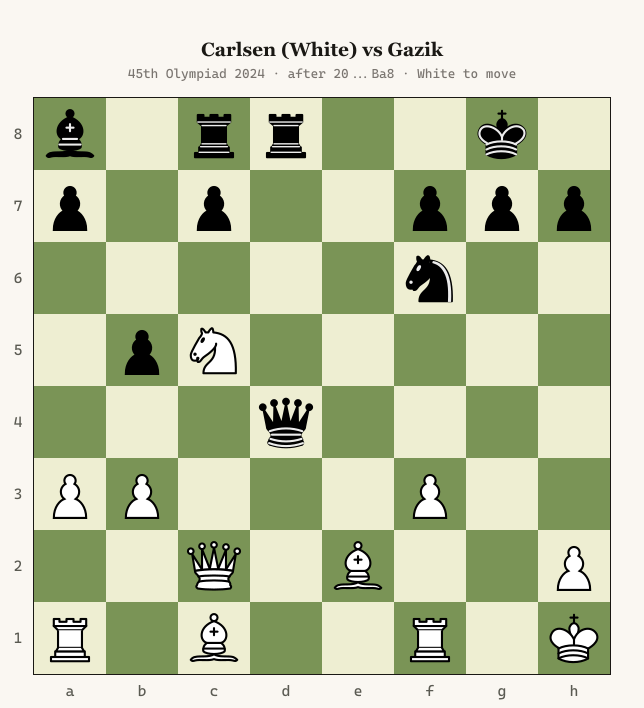
Before reading further: Stockfish rates this position +182 for White — near winning. Central Control Score rates it strongly for Black. Which side does the board look like it favours?
Black's queen has marched to d4, deep in White's position, and the knight on f6 is well developed, controlling central squares. The rooks on c8 and d8 sit on the two central files that are freest of pawns. On the surface, Black looks active and central. But look closer at what that activity is doing: the queen on d4 has no follow-up threat, and the bishop on a8 — which just retreated there — is completely undeveloped, doing nothing. White, meanwhile, has a knight parked on c5, a genuine long-term outpost eyeing b7, a6, d7 and e6, plus a safely castled king. White's actual plan is simple: consolidate (the engine likes the quiet Ra1-a2), meet the queen's incursion, and let the c5 knight do its work over time. Black's central presence is real but has nowhere to go — which is exactly why the engine, unlike Central Control Score, is not impressed by it.
What Stockfish sees that CCS misses: that Black's central activity has no concrete follow-through — the queen's raid on d4 threatens nothing specific, and White's knight on c5 is a durable structural asset the engine's search can see paying off over the following moves, not just in the current snapshot.
What CCS makes visible that the engine number does not explain: a bare "+182 for White" suggests a comfortable, low-tension position. The board shows the opposite: Black's queen is deep in White's camp and both rooks sit on the only semi-open central files — real, currently-dangerous central presence that a single evaluation number doesn't communicate.
What "opening fit" might actually mean
Put the pieces together and a more interesting idea than "which repertoire is better" starts to form. Opening fit, if the term means anything at the level Carlsen and Caruana play at, does not seem to mean obtaining a higher average engine evaluation out of the opening. Both approaches, in this data, get to equally good positions on average.
We haven't measured what each repertoire demands in actual study hours or memorised depth — only the shape of the repertoire and what each player has said about his own process. With that limit stated plainly: Caruana's repertoire architecture appears naturally compatible with depth, repetition and extensive prior verification. Carlsen's appears compatible with broader positional familiarity, move-order flexibility, and confidence once the prepared phase of a game ends.
Neither is the objectively stronger way to reach move 20. Each looks like a working answer to a different underlying question: given how this specific player studies, remembers, and decides at the board, what repertoire lets him arrive there most reliably, ready to play well? That is a claim about fit between a repertoire and a player's way of building and using competence — not a claim about which repertoire scores higher on a computer.
The lesson for a club player
Here is where the story changes for anyone rated 1200 to 2000, rather than 2750 to 2850.
Carlsen and Caruana can make a very wide range of sound openings work, even when a given position doesn't perfectly match their most obvious strengths — because both have enormous compensating resources: preparation support, years of accumulated calculation ability, and a breadth of general chess understanding that covers for whatever a narrower or broader repertoire might otherwise expose. A club player usually doesn't have any of that to fall back on. If a repertoire doesn't fit how you actually study and how you actually decide at the board, there is no seconds' team and no twenty years of world-class technique standing behind you to cover the difference.
That's the practical version of "opening fit" for most players: not whether a line is objectively best according to an engine, but whether it fits the study time you actually have, the way you actually prefer to learn a position, the kinds of structures you can reliably navigate over the board, and the way you actually make decisions when the clock is running and the preparation has run out. A repertoire built around six hours a week of focused study behaves differently from one built around forty minutes squeezed in after work — regardless of which one an engine would rate half a pawn higher in some reference line.
And copying a grandmaster's opening choice is not the same as copying the system that makes it work for him. Playing the London System because Carlsen has played it, or a Berlin Defence because Caruana has, borrows the move order without borrowing the years of technique, the study habits, or the decision-making patterns that make that particular repertoire fit that particular player. The moves are public. The system behind them isn't something you can copy from a database.
Six positions, two different readings
These six positions are the same ones referenced throughout the article — selected in advance to show engine/CCS agreement and disagreement, not sampled at random or picked after the fact. Engine evaluation and Central Control Score are two different lenses, not a contest: neither is presented here as superior to the other, and none of the CCS readings below is a claim that CCS predicts who wins. Click any position to expand it.
Engine and CCS agree
Carlsen–Srihari, Qatar Masters Open 2023
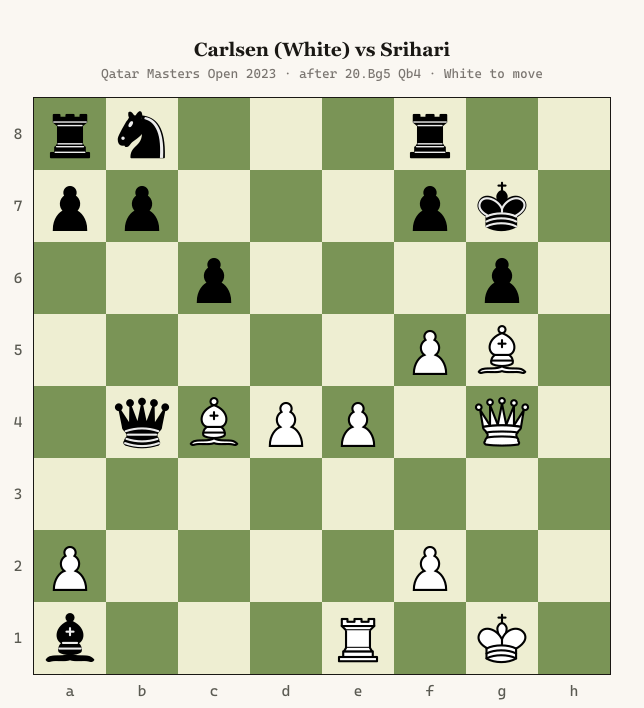
| Players | Carlsen, M. (White) vs. Srihari, L R (Black) |
| Event / date | Qatar Masters Open 2023 · 2023.10.11 |
| Move / side to move | After 20.Bg5 Qb4; White to move 21 |
| Opening | Slav / Queen's Gambit Accepted |
| Stockfish cp (target-player) | +513 |
| WDL / expected score | 1000 / 0 / 0 · 1.000 |
| CCS net (target-player) | +7.5 (White 17.9 – Black 10.4) |
White's queen (g4) and bishop (g5) are aimed directly at Black's king on g7, with the f5 pawn about to open the position further; Black's queen (b4) and lone bishop (a1) are active but disconnected from the kingside where the game is actually being decided. The same pieces producing White's mating attack — the queen and bishop bearing on the center and kingside — are exactly what CCS's occupation and control terms are pricing in. This is the clean case: a real central/kingside space and piece-activity advantage that is also concretely winning.
What Stockfish sees: the specific mating pattern (Bf6+ followed by mate or decisive material gain on g7/h6) — CCS has no king-safety or concrete-tactics term; it would score this position similarly high even if Black's king were safer, since it only measures central occupation/control, not the attack itself.
What CCS makes visible: cp+513 alone doesn't distinguish "won by a mating attack out of nowhere" from "won by a slow central squeeze" — CCS's breakdown (control=8, driven by the g4/g5 pieces owning central and kingside squares uncontested) shows this was a structurally-earned advantage, not a one-move tactical accident.
Yoo–Caruana, 2024 U.S. Championship
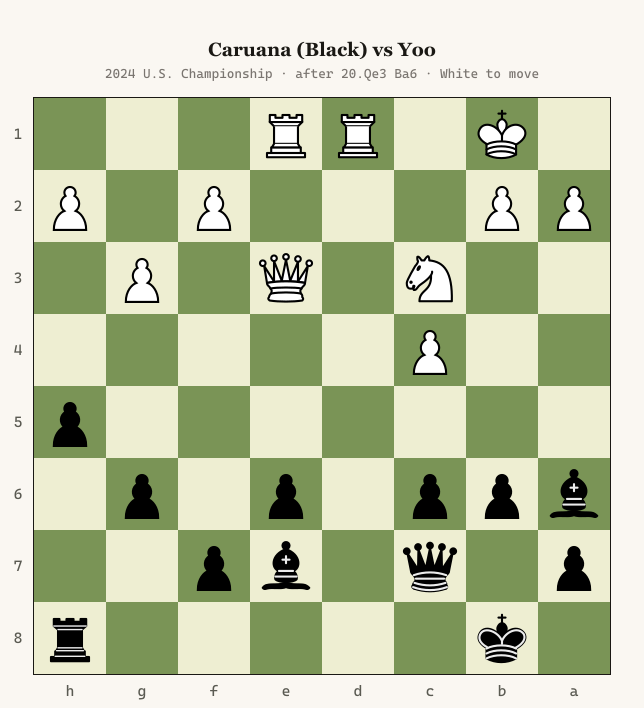
| Players | Yoo, Christopher Woojin (White) vs. Caruana, F. (Black) |
| Event / date | 2024 U.S. Championship · 2024.10.16 |
| Move / side to move | After 20.Qe3 Ba6; White to move 21 |
| Opening | Réti / English (flank) |
| Stockfish cp (target-player, Caruana/Black) | −126 |
| WDL / expected score | 0 / 172 / 828 · 0.086 |
| CCS net (target-player) | −8.1 (White 16.4 – Black 8.3) |
White's rooks are doubled on the central d/e-files with a knight and queen centralized (Nc3, Qe3); Black's bishops are both passive — the a6-bishop boxed in by its own b6/c6 pawns, the e7-bishop blocking Black's own rook. Both measures see the same thing: White's pieces are simply better placed around the center, independent of any immediate tactic. (Caruana went on to win the game regardless — this snapshot describes the move-20 position, not the outcome.)
What Stockfish sees: why Black's bishops are bad — CCS counts central occupation/control, not whether a piece is blocked by its own structure. A reader would need to see the board to understand the a6-bishop is bad specifically because of Black's own b6/c6 pawns, not because of anything White is doing to it directly.
What CCS makes visible: cp−126 alone doesn't say how White is better — CCS's rook-sniper component (elevated by the open/semi-open central files under White's doubled rooks) shows the advantage is specifically a central-file, not a wing or purely material, advantage.
Engine positive, CCS negative
Carlsen–Gazik, 45th Olympiad 2024
| Players | Carlsen, M. (White) vs. Gazik, Viktor (Black) |
| Event / date | 45th Olympiad 2024 · 2024.09.14 |
| Move / side to move | After 20...Ba8; White to move 21 |
| Opening | Queen's Indian Defence |
| Stockfish cp (target-player) | +182 |
| WDL / expected score | 989 / 11 / 0 · 0.9945 |
| CCS net (target-player) | −15.1 (White 3.4 – Black 18.5) |
See "One position, two readings" above for the full worked explanation of this position — reproduced here for completeness alongside the other five.
Caruana–Gukesh, 13th Norway Chess 2025
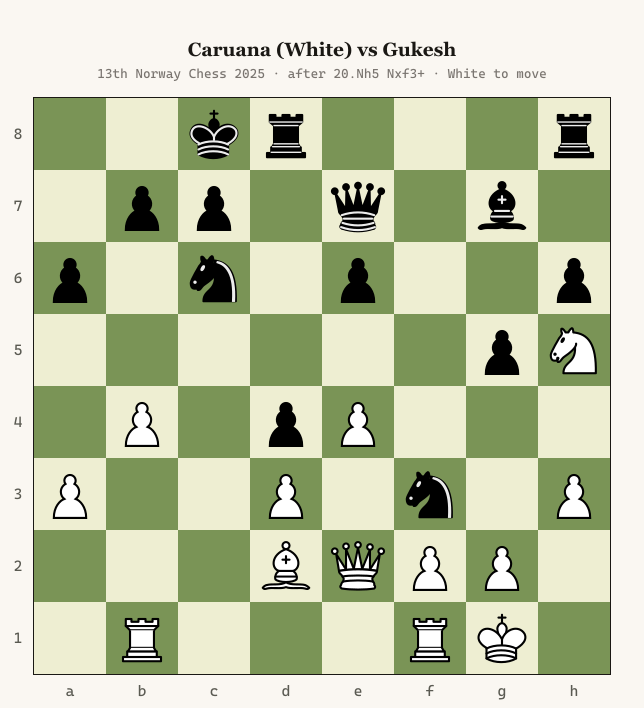
| Players | Caruana, F. (White) vs. Gukesh, D. (Black) |
| Event / date | 13th Norway Chess 2025 · 2025.06.06 |
| Move / side to move | After 20.Nh5 Nxf3+; White to move 21 |
| Opening | Open Games (1.e4 e5) |
| Stockfish cp (target-player) | +96 |
| WDL / expected score | 444 / 556 / 0 · 0.722 |
| CCS net (target-player) | −11.5 (White 11.4 – Black 22.9) |
Black has a knight sitting on f3 — deep in White's camp, next to the king — plus an advanced d4 pawn, a second knight on c6, and a fianchettoed bishop on g7: a genuinely intimidating, central-control-heavy setup, which is exactly what CCS's large negative score reflects. But White's own move, Be2-f3, offers to trade off the intruding knight directly; once that trade happens (or if White simply castles the position out), Black's central presence stops being a concrete threat. The engine's much smaller edge here (+96, near-even WDL) versus the Gazik position's +182 correctly reflects that Black's activity, while real, is closer to being fully compensated — a good illustration that "CCS strongly negative" does not always mean "engine number is far off"; sometimes it means "the position is genuinely sharp and close."
What Stockfish sees: the direct tactical resource (Bxf3) that neutralizes Black's most dangerous piece — CCS scores the f3 knight as a large central-control asset for Black regardless of whether it survives the next move.
What CCS makes visible: a near-equal cp number (+96, WDL close to 50/50) might suggest a quiet, balanced middlegame; the board is anything but — Black's central/kingside piece concentration is real and would matter enormously if White mishandled the position, which the raw evaluation number doesn't communicate on its own.
CCS positive, engine negative
Nakamura–Carlsen, 12th Norway Chess 2024
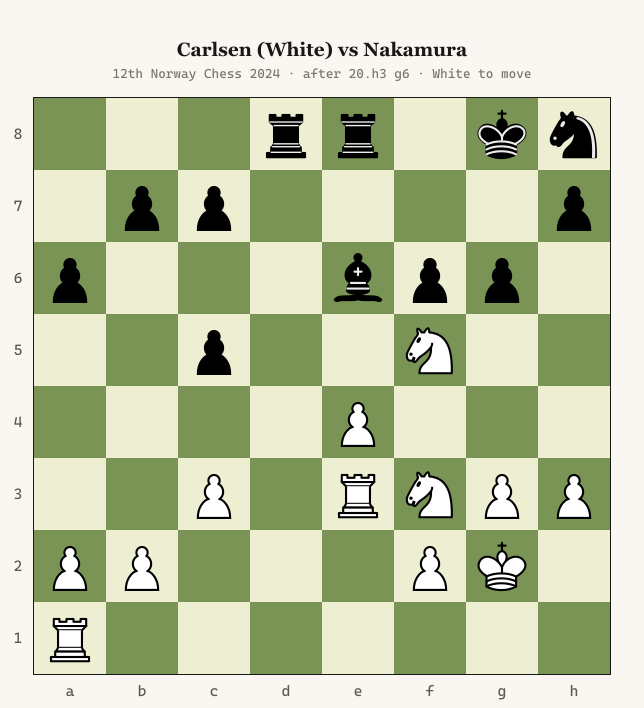
| Players | Carlsen, M. (White) vs. Nakamura, Hi (Black) |
| Event / date | 12th Norway Chess 2024 · 2024.05.28 |
| Move / side to move | After 20.h3 g6; White to move 21 |
| Opening | Ruy Lopez |
| Stockfish cp (target-player) | −51 |
| WDL / expected score | 0 / 958 / 42 · 0.479 |
| CCS net (target-player) | +9.1 (White 18.9 – Black 9.8) |
White has two well-placed knights (f5 is a genuine outpost next to Black's king, f3 is centrally flexible) and doubled rooks, against a Black setup where the h8-knight is completely offside and undeveloped — visually and structurally, White looks like the more active, centralized side, which CCS registers strongly. But the engine finds Black's position resilient: with no clear way for White to convert the extra space into anything concrete (and WDL showing a near-certain draw either way), the small negative cp likely reflects specific pawn-structure factors (e.g. White's e4/c3 pawns as long-term targets) that outweigh the space advantage in precise calculation, even though they don't show up as "central control" in CCS's terms.
What Stockfish sees: long-term static weaknesses in White's own structure (the e4 and c3 pawns as potential future targets) that offset the space advantage — CCS rewards current central presence without assessing whether it comes with liabilities elsewhere.
What CCS makes visible: cp−51 (a marginal Black edge) does not suggest White holds any kind of practical advantage — the board tells a different story, with White's two active knights and extra space making this a position Black has to handle carefully despite the "better" evaluation, exactly the practical nuance CCS is positioned to add.
So–Caruana, GCT Super ROM Classic
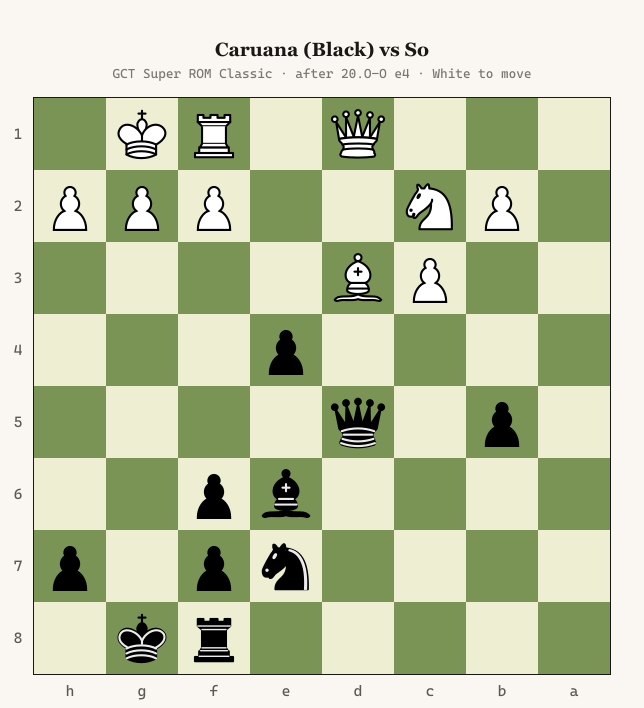
| Players | So, W. (White) vs. Caruana, F. (Black) |
| Event / date | GCT Super ROM Classic · 2026.05.16 |
| Move / side to move | After 20.O-O e4; White to move 21 |
| Opening | Sicilian Defence |
| Stockfish cp (target-player, Caruana/Black) | −38 |
| WDL / expected score | 0 / 980 / 20 · 0.490 |
| CCS net (target-player) | +11.5 (White 5.4 – Black 16.9) |
Black's e4 pawn is deep in White's half of the board, backed by an actively centralized queen (d5) and supporting minor pieces (Be6, Ne7) — a textbook central-space advantage that CCS scores heavily. Yet the engine sees only a marginal White edge: an advanced, unsupported pawn like e4 is a double-edged asset — it cramps White now, but if White can attack it (with f3, or manoeuvring a knight to a square that pressures it) it can become a long-term weakness rather than a strength. The engine's calculation evidently judges the pawn's prospects skeptically enough to call the position roughly balanced, even slightly better for White, despite Black's clear spatial dominance on the board.
What Stockfish sees: the double-edged nature of an advanced, potentially overextended pawn — CCS credits central space in the moment without judging whether that space is sustainable or will become a target.
What CCS makes visible: a near-equal cp number gives no hint that Black currently dominates the center spatially — a reader would reasonably picture a quiet position from "−38, drawish," when the board shows a sharp space imbalance whose resolution (does the e4 pawn hold, or does it fall) is exactly what will decide the game's character going forward.
Note on selection: these six were chosen specifically to illustrate divergence and agreement, not sampled at random — they are not representative of the overall (near-zero) correlation on their own, and are presented as worked examples, not as evidence of correlation strength.
Continue the Opening Fit investigation
This article is the first in the RBOTChess Opening Fit Project. The next installment will examine World Champion Gukesh and his 2026 challenger, Javokhir Sindarov, ahead of their World Championship match.
A full Methods, Data and Statistical Appendix, including sample construction, exact definitions, engine settings, complete results, robustness checks and data-integrity notes, is available here.
Sources
- World Championship Game 2: Preparation counterpunch — ChessBase, 2018 — on Caruana's game-2 preparation.
- Magnus Carlsen — "I don't quite fit into the usual schemes" — ChessBase — on Carlsen's stated approach to opening study.